
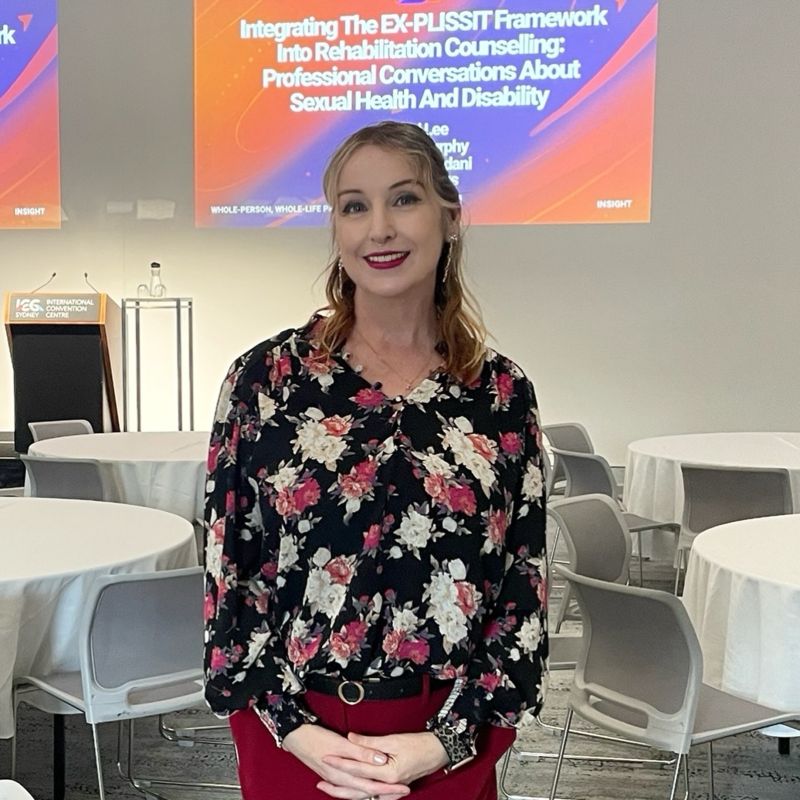
Today I had the privilege of presenting alongside brilliant colleagues at the ICC in Darling Harbour for the ASORC – Australian Society of Rehabilitation Counsellors National Conference. My first Master’s degree was in rehabilitation counselling, and while I no longer work as an RC, I am a strong advocate for this valuable profession. It was a genuine pleasure to speak about the important role that sexology can play within multidisciplinary rehabilitation, and why sexual wellbeing deserves to be recognised as part of holistic, person-centred care rather than something left unspoken.
Our presentation explored the Ex-PLISSIT model, a practical framework that helps rehabilitation professionals confidently address sexual health concerns within their scope of practice. The model emphasises giving clients permission to raise sexuality-related concerns, providing limited information and specific suggestions where appropriate, and recognising when more intensive therapy from a qualified sexologist or psychosexual therapist is indicated. Rather than expecting every rehabilitation counsellor to become a sex therapist, the Ex-PLISSIT model empowers clinicians to respond competently and compassionately when these conversations naturally arise.
We also discussed how this approach is highly relevant across Australian rehabilitation settings, including supporting people recovering from workplace injuries, military veterans, police officers, first responders, and clients navigating return-to-work following illness, injury, disability, or psychological trauma. Sexual wellbeing is often affected by pain, medication, changes in identity, relationship stress, mental health, and physical functioning, yet it is rarely discussed in rehabilitation. It was wonderful to see such engagement with this topic, and I’m hopeful that conversations like these will continue to broaden our understanding of what truly holistic rehabilitation looks like.
Reach out if you are a professional who would like to learn more about using the Ex-PLISSIT model in your practice. Also, I have a free booklet on the topic available here.